JACK KIRBY, VINCE COLLETTA AND THOR – ASGARD REALIZED

Vince Colletta Romance Covers

An inspiration came to Jack Kirby one day. This wasn’t unusual since Jack’s mind was in a constantly creative mode. The moment he and Stan Lee made the decision to move forward with the Asgardian adventures of Thor the Thunder God, all of comicdom stood up and took notice. From the start, as it became the new feature saga in the Journey into Mystery series, the concept was a hit.
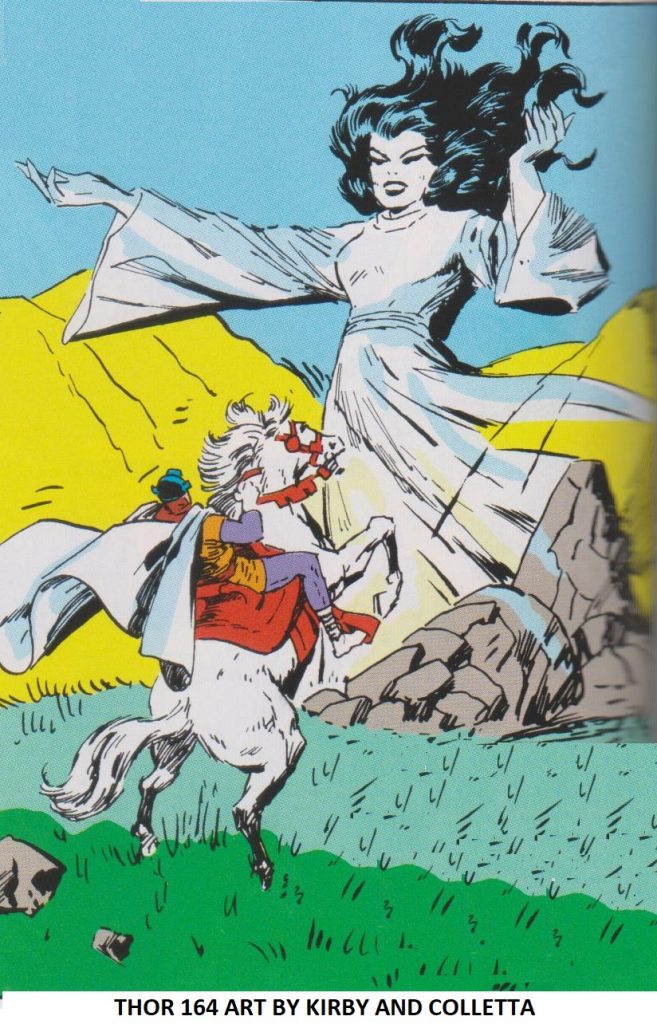
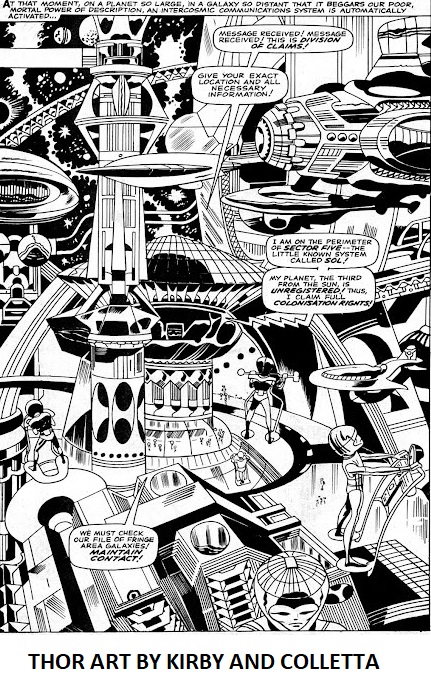
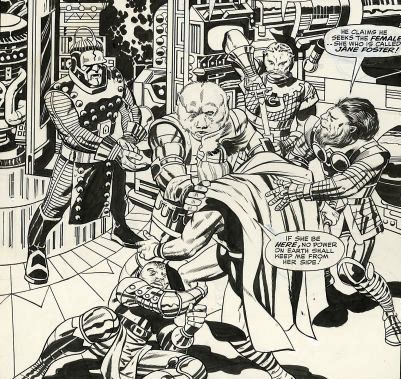
Illustrative Thor Art by Jack Kirby and Vince CollettaBeginning with issue #83, Journey into Mystery  became Thor’s book. Jack penciled most of the covers and stories, of course, while the finished art was supplied by various inkers such as Joe Sinnott, Dick Ayers, Steve Ditko, Al Hartley, Sol Brodsky, George Ruossos, Chic Stone, Paul Reinman and Don Heck. Using bold, graphic-style inks, the stories were good but the art resembled most of  Marvel’s other books. That is until issue # 106 when Thor was transformed from contemporary to primal. The mythological land of Asgard was born.

Scooter: Damn! My whole world’s falling apart…(actually I quite like Vinnie’s Tales of Asgard work).

Lyle Tucker:    Here’s where we differ – I LOVE Vinnie’s Tales of Asgard work.

Dane Bjorklund: Several of the early THOR and Tales of Asgard issues were inked by a gentleman named Vince Colletta. I think that his name has become linked with his THOR work and the THOR comics that Mr. Colletta inked were among the best. THOR #126 is my favorite comic book cover of all time, drawn by Jack Kirby and Vince Colletta.
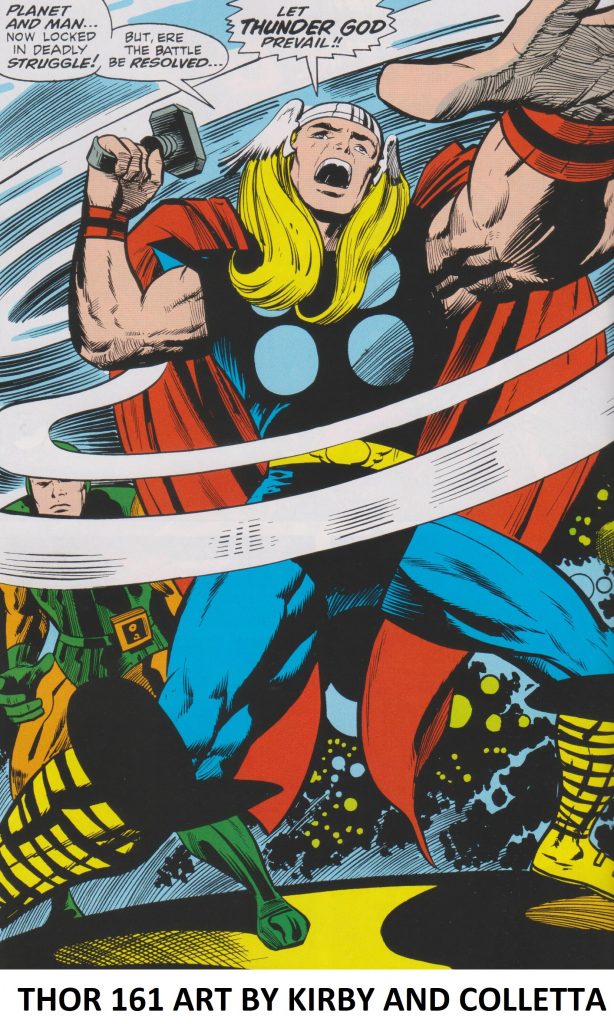
Graphic Thor Art by Jack Kirby and Vince CollettaVince Colletta had always admired the great artist and storyteller Hal Foster.  The delicately rendered Prince Valiant stories gave my father the idea of speaking to Stan and Jack about presenting Thor in a different light. By creating a rough-hewn world more reminiscent of Norse legends, Journey into Mystery’s backup story, Tales of Asgard, gave readers a glimpse into Thor’s world. And right from the first story the controversies began. While Tales of Asgard was hailed as a creative breakthrough by most – I remember the pride that Vinnie felt reading and hearing the accolades – some comic book fans voiced displeasure with the artistic departure.

Rick Young: It amazed me the first time I saw criticism of Vince Colletta’s work. I get that he simplified some of Jack’s backgrounds and I like those intricate details. This panel (This Battleground Earth) has such a rich/finished look that is typical of Kirby & Colletta.

Erik Larsen: In the back issues I recently bought there were rave letters when Vinnie started inking Tales of Asgard.

Erik Larsen: But please–don’t confuse popularity with quality. McDonald’s has served billions of hamburgers, after all.

Pierre Comtois: Overnight it seemed, with Vince Colletta replacing Stone, the regular Thor strip acquired the same timeless, antique feel as Colletta’s work over Kirby in the Tales of Asgard feature.  The inking style changed the whole feel of the book, making even down-to-earth stories such as those featuring the return of the Absorbing Man seem grander than they would’ve been with Stone.  Whether it was the inspiration of Colletta’s inking, a continuation of the kind of stories that they’d been telling in Tales of Asgard or simply the trend that Marvel had been drifting towards through its first two phases, Lee, Kirby and Colletta now launched the Thor strip into an unprecedented series of inter-connected stories whose structure was unlike anything done in comics before.

The fine line work, delicate cross-hatching and detailed delineation of anatomical features were a source of annoyance to readers used to seeing “comic book art.” But by issue #116, Journey into Mystery, Thor and Asgard were all Jack and Vinnie and they became what many fans and professionals alike still feel is the greatest comic-book series ever – Thor.

David Philpott: I enjoyed the Kirby/Colletta Thors as a kid (bought as back issues). And I still enjoy them 25 years later. They are quality entertainment. The Tales of Asgard back ups rocked.

Allen Montgomery: I got the Tales of Asgard hardcover not too long ago. They were definitely playing to the newsprint back in the day. And not just Colletta. All the inkers turned in some pretty rough work. Colletta was the only one that attempted texture of any kind. The rest seemed to favor the “blotch” technique.

George: I don’t think Thor as a book worked until Colletta came on board. As good an inker as Stone was on Kirby he was too nice for the Asgardian world. The only other inker who came close was George Roussos in some of the early “Tales of Asgard”.

Al Sjoerdsma: I am among the minority who actually like Colletta’s inking on Kirby’s Thor, bringing it an airiness that fits into the fantasy of that strip.

Klar Ken T5477:  I like VC’s inking on Thor too. Why not denigrate Chic Stone or Syd Shores as well? Vinnie met his deadlines and his work on the Kirby DC’s was far superior to Royer and D. Bruce Berry.

Mark Engblom: You’re right….Colletta did a pretty good job on the Kirby Thor comics. Just as with Sinnott’s inks, Colletta was able to “soften” the blunt and (occasionally) grotesque extremes of Kirby’s pencils.
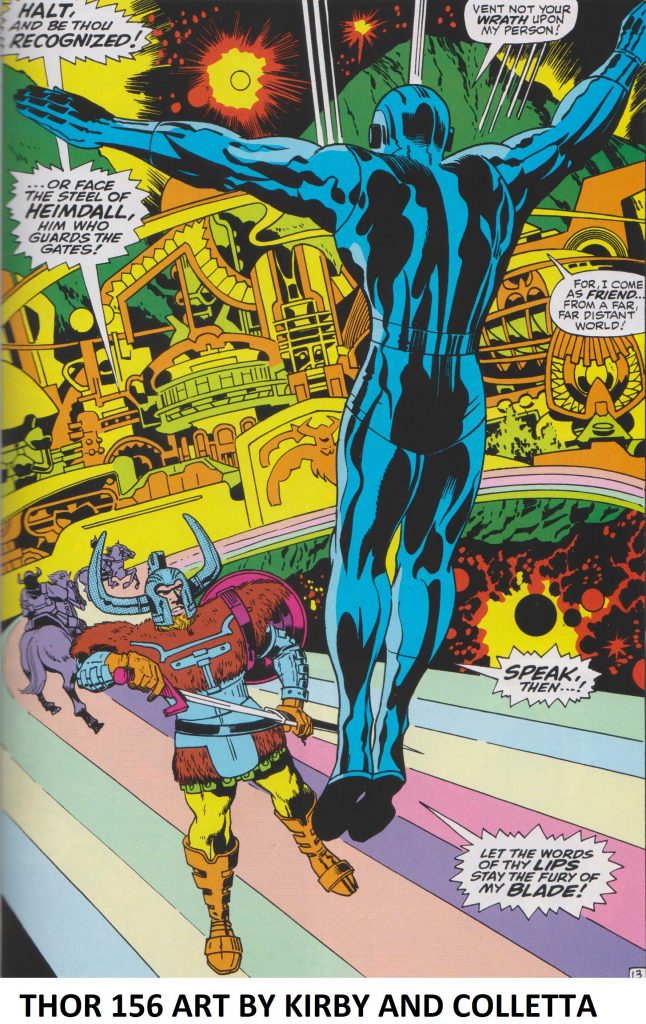
Slick and Detailed Thor Art by Jack Kirby and Vince Colletta

A common criticism of Vince Colletta’s superhero inks has to do with the numerous “scritchy-scratchy” pen lines he used to define musculature. Rather than the quick brush swipes and symmetrical shadow lines used by others, Vinnie preferred the illustrative approach he learned in art school working with oils. He has been unfairly pigeonholed as one-dimensional, however, as the image above clearly proves, Colletta could ink in a bold, graphic style with the best of them.

PunyHuman: Beautiful, positively Beautiful (Tales of Asgard)!! What a spectacular collection !!

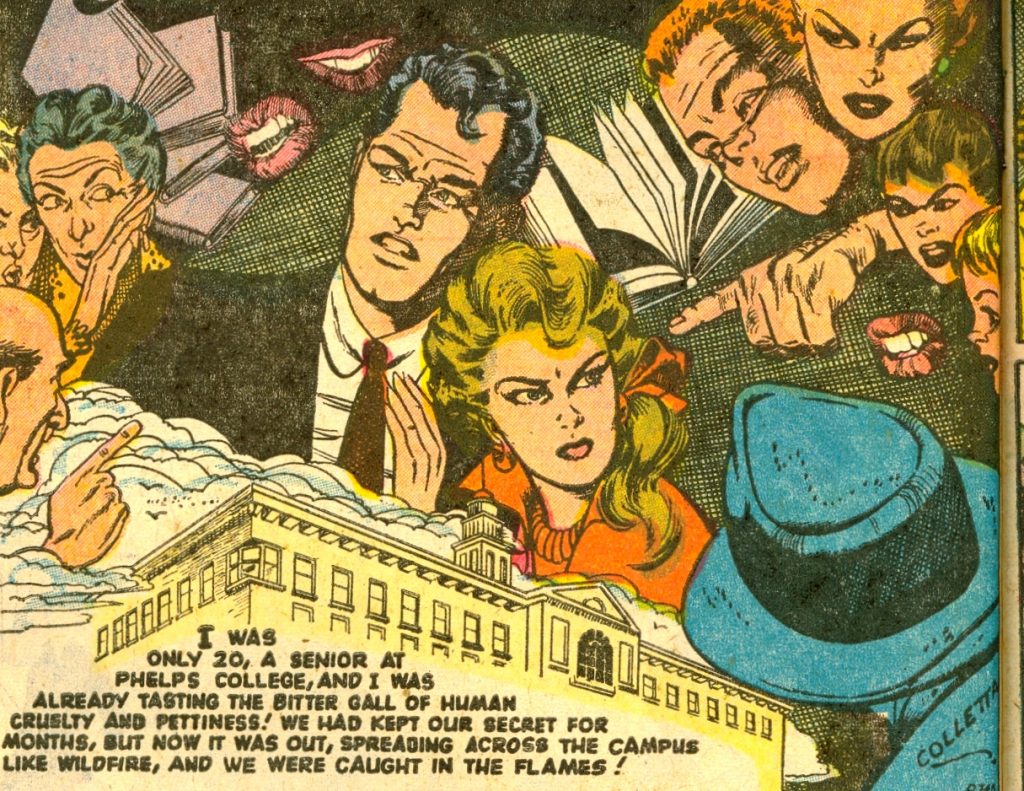
Tom Lammers: I know a lot of folks don’t like Colletta as an inker, especially over Kirby pencils, but I say as a penciler for this kind of story, he is excellent. He had a real flair for capturing emotion, as the heroine vacillates between sheer joy and dejection, interspersed with uncertainty, pensiveness, and regret.

Jay Kinney: There are some people, me included, who think that the “Tales of Asgard” artwork is the best of any by good old Jack. Vince’s inkings are great and seem to catch the ancient flavor.

Andrew W. Farago: Not to damn these books with faint praise, but Thor’s got to be the best superhero inking of Vince Colletta’s career (Colletta’s romance art has its moments). In black and white, especially in the Tales of Asgard stories, there’s a bit of a Prince Valiant vibe to the artwork which I don’t think would have been there with someone like Joe Sinnott inking the series, which probably would have taken the book in entirely different directions.

Alan Kupperberg (Former Marvel Artist): And then, my last issue 328. Vinnie Colletta finally inks my Thor. I went out with nice inks.

Lyle Tucker: I love those Colletta THOR’s (and especially the TALES OF ASGARDS) and I stopped buying NEW GODS after Royer came aboard, because by that time Kirby needed Vince’s artistic eye to “fix” his increasingly sloppy work – for whatever that’s worth, I thought I’d set the record straight as far as where I stand on the merits of Vince’s inking (and, yes, he DID indeed draw some damn fine romances in the ’50s).”

Norris Burroughs: The amount of inking on this page alone (THOR 142) would overwhelm a less than confident inker, so we must praise Colletta for his sheer tenacity and remember that he was often called on to finish Kirby’s detailed pencils in order to meet a deadline.  Yes, he can be criticized for his faults, but we can also praise him for his strengths and accomplishments.

David J. Bromley: Many thanks for the even approach to a misunderstood & talented inker. Colletta had a ‘fine art’ approach that many cannot understand.

Aaron Noble: It’s in the “anatomy and fine detail” that you appreciate Colletta’s contributions.

jon m: Thor was a good book for Colletta, as opposed to FF which was a horrible match. I actually preferred his inks on the Fourth World books over Royer. Maybe it just eased the transition to DC.

Ian Miller: It’s sad that Colletta gets such a bad rap, because he was capable of some amazing work. If you ever get the chance to see any of the Kirby Thor pages he inked in person you’ll definitely see that he had some great chops. His feathering and fine linework took Kirby’s art in a more refined direction that you never really saw other inkers take advantage of.

Index of articles www.vincecolletta.com

WHO’S YOUR DADDY, THOR?

Vince Colletta Romance Covers

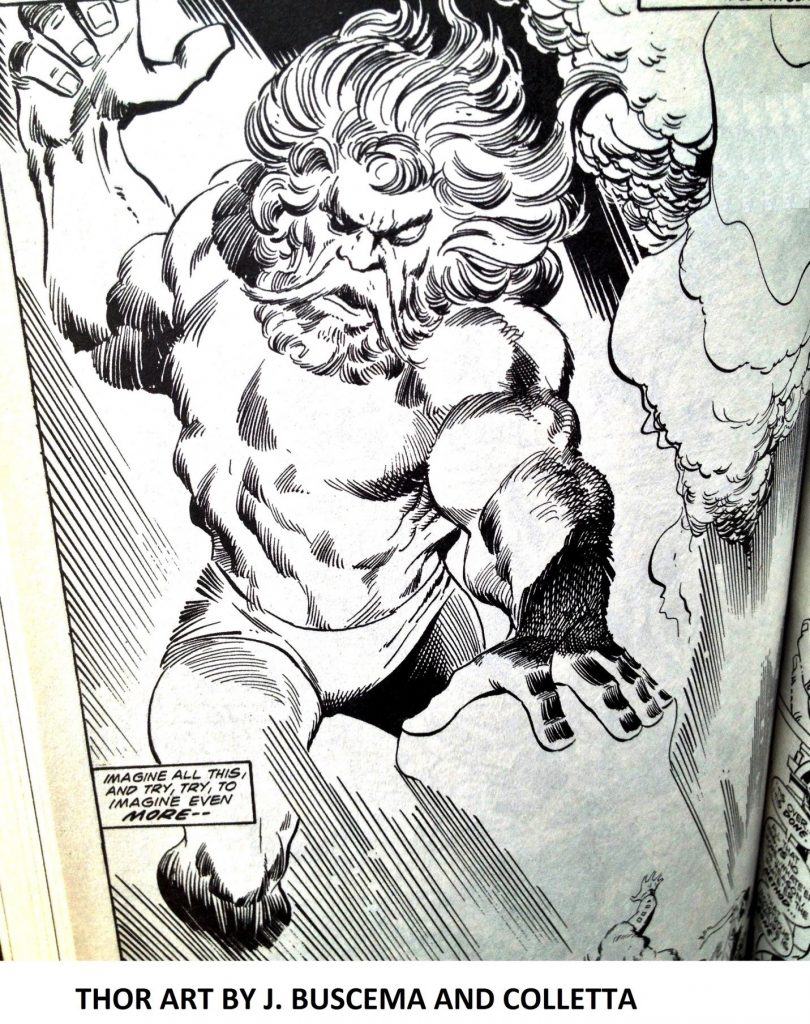
This is an impressive man, er…God would be a more appropriate nomenclature. A pinnacle of superhero art. In comic book lore, Odin is a Norse God widely-known as the father of Thor, the Thunder God. Henry Petersen’s doctoral dissertation in 1876, proposed that Thor was the indigenous god of Scandinavian farmers and Odin a later god proper to chieftains and poets. Odin appears in Marvel Comics and in the Marvel Cinematic Universe as the king of Asgard and as the father of Thor and the adoptive father of Loki. In the comics, he was not drawn without his missing right eye for years.

THOR ART BY JOHN BUSCEMA AND VINCE COLLETTA

Odin has been a source of inspiration for artists working in fine art, literature, and music for centuries.

Odin

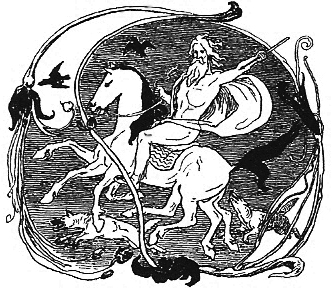
Odin sits atop his steed Sleipnir, his ravens Huginn and Muninn and wolves Geri and Freki nearby (1895) by Lorenz Frølich.

Odin Throwing a Spear

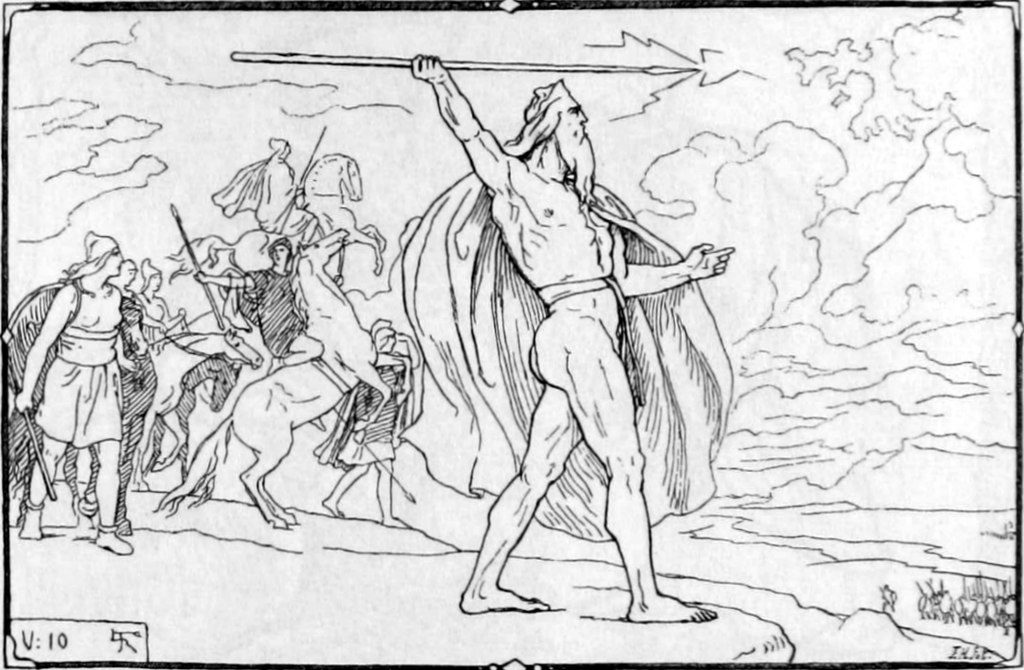
Odin throws his spear at the Vanir host in an illustration by Lorenz Frølich (1895)

Index of articles www.vincecolletta.com

JACK AND VINNIE – FROM START TO FINISH

Vince Colletta Romance Covers

Jack Kirby and Vince Colletta – together forever in both fame and infamy. The Kirby legacy is the architect of numerous memorable comic book characters, penciler of dramatic scenes and contributor to the stories we read throughout his career. The Colletta heritage includes being acknowledged as the illustrator of the most beautiful women in comics, go-to guy when deadlines loomed as well as the most prolific creator of any artist in the industry.

Jack and Vinnie worked tirelessly for decades, forgoing vacations and family time in order to earn the incomes necessary to support their respective lifestyles. Both artists made life-changing decisions to escape city life in order to provide their wives and children with upscale environs where they could thrive. These choices meant they would have to spend countless hours each day at their drawing boards. Kirby was a relentless creator while Colletta became the tireless icon of the industry’s need to meet critical cut-off dates. Jack can be credited with originating the stories. Vince can be credited with saving the books.

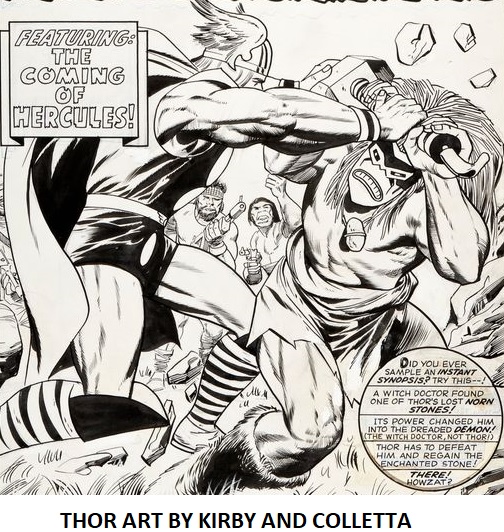
THOR ART BY JACK KIRBY AND VINCE COLLETTA

Pencilers and inkers are typically a different breed from one another. Both require specialized skills. Kirby and Colletta began their careers doing both. Jack drew cowboys, monsters, superheroes and other genres while Vince mainly drew romance books in addition to the occasional fantasy, crime and jungle stories. Each man became preeminent on his respective path. Eventually, however, an artist will come to rely on his or her strong suit in order to succeed. Kirby was not a production inker while Vinnie was. Vinnie did not have the capability of creating insanely-complex machinery and outlandishly rough-and-tumble panels while Jack did. Comic book historians have come to regard Kirby as primarily a penciler and Colletta as principally an inker. Perhaps it was inevitable that they became one of the most enduring art teams in history.

In the early 1960’s, Kirby was penciling stories featuring the character THOR for Marvel Comics. Colletta had a considerably different vision of what the THOR stories should look like. Based on the Hal Foster Prince Valiant books, Vinnie created samples displaying his vision of the Asgardian word of THOR. He took these drawings to editor Stan Lee who instantly fell in love with the illustrative look. Thus, after discussing the proposition of a separate feature with Kirby, Tales of Asgard was born in Journey into Mystery 107 in August, 1964. Shortly thereafter, beginning with Journey into Mystery 116, THOR began it’s lengthy run with Kirby and Colletta as the principal artists.

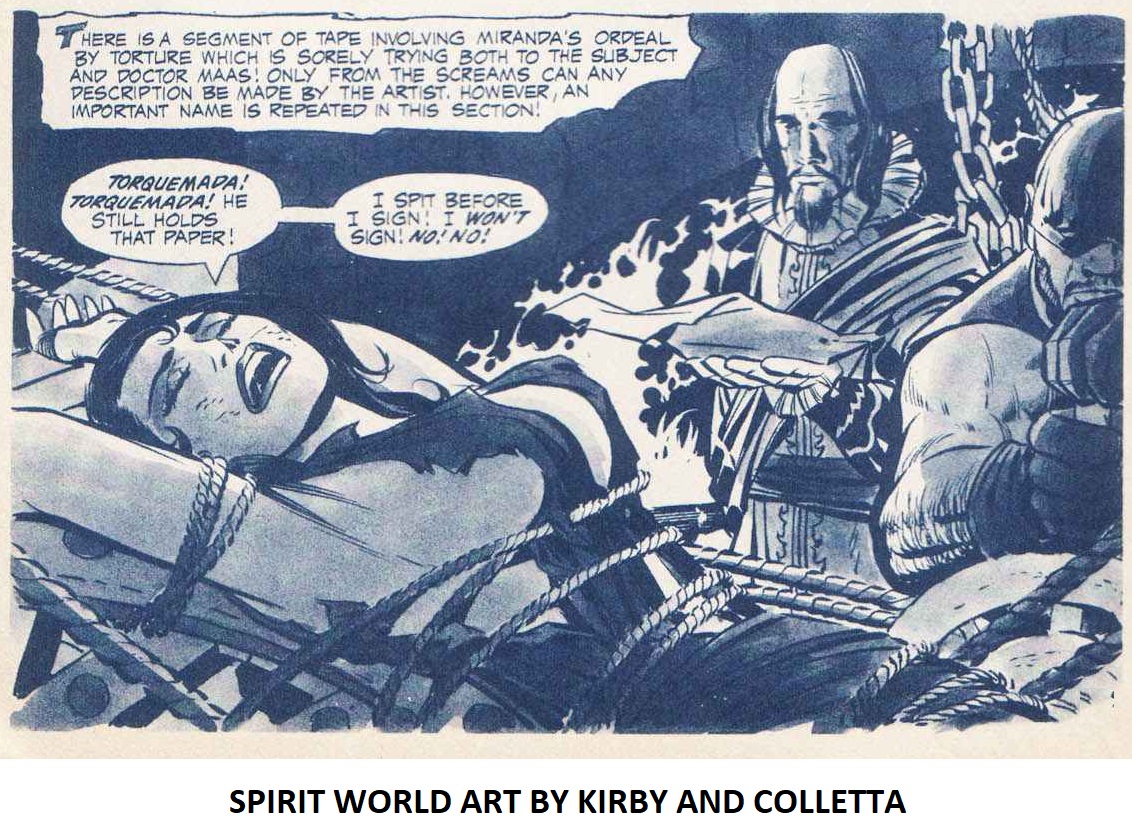
SPIRIT WORLD ART BY JACK KIRBY AND VINCE COLLETTA
The Kirby and Colletta team created countless memorable books together but the unquestionable highlight was THOR. In March 1966, the character was given his own book, THOR 126. By this time, Vince was the primary inker over Jack’s exquisite pencils. Dissimilar to all other comic book drawings, the finished product resembled fine art from an earlier time. While all of Kirby’s grandeur was retained, gone were the graphic swipes of India ink used by all other inkers to depict both the characters and their surroundings. The departure drew raucous praise from readers and art aficionados alike. While this elegant look was not suitable for most comic books, in THOR it found a home.

While both men prospered beyond any of their peers, success was not without the attendant criticisms. Kirby had adversarial relationships with management at both Marvel and DC while Colletta developed a reputation for taking short-cuts in order to make his job easier. They have been the subject of many tales and rumors throughout the years. Anyone who succeeds in reaching the top inevitably has to deal with the arrows and slings that are hurled their way in the form of gossip. Since there are so many rumors involved, it is difficult for people to determine whether the claims are factual. What is evident is that without Jack Kirby, Marvel Comics would have very few of the popular superheroes that they own and exploit in books and movies. What is also evident is that without Vince Colletta, hundreds of Marvel and DC monthly releases would have been a regurgitation of seemingly-endless reprints that could have significantly altered company destinies.

The lawsuits involving Kirby and DC editor Jack Schiff surrounding the Skymasters newspaper strip resulted in Jack’s banishment from DC Comics. His issues with Marvel over ownership of characters are also well-documented. While the publishers were less than happy with him, comic book fans mostly sided with Kirby. With Colletta, the main controversy was that he erased and otherwise simplified the penciled art. Most people do not understand the role of what is essentially a publisher’s mercenary. Marvel and DC knew that Vinnie was both willing and capable of making up for the shortfalls of others in order to meet printing deadlines so they exploited him. While the publishers loved him, many pencilers and comic book fans alike voiced their displeasure.

THOR ART BY JACK KIRBY AND VINCE COLLETTA
In 1971, tired of quarreling with Marvel, Jack was welcomed back to DC Comics. The publisher created banner advertisements heralding the coming of Kirby who was now more well-known by readers. He brought with him a vision that he named The Fourth World. While never achieving the successes at DC that he did with Marvel, the concepts were innovative. Colletta had been working with DC Comics at the time leading to management’s decision to put Vinnie on Jack’s Fourth World books, including The New Gods.

Kirby had worked with Colletta for years and understood that, in addition to his own stories, the editors were also giving Vinnie an armload of other books each week. Almost all of these were late jobs due to pencilers or editors foul-ups but they needed to be completed quickly so Vinnie hacked them out. The finished art lacked most of the abundant illustrative flourishes he was known for but they were always accurately-inked and the work got done. In the past, Kirby was fine with whatever alterations Vinnie made. Some say they made the pages more readable while others abhorred them. Jack was eventually convinced by those around him to confront Vinnie about some of the liberties he was taking. Their meeting resulted in the end of an acclaimed art team. Colletta always lavished great detail on the main characters and assured Kirby that it would continue. But the inker simply could not promise to ink every line, every doodle, every background building, every tree, etc. without sacrificing his other assignments. A Jack Kirby splash page showing intricate machinery would take most inkers a week to finish. Jack was fortunate to find another competent inker who had no other assignments and could focus on just inking Kirby. And so, a handshake sealed the deal. Both Jack and Vinnie continued on their respective paths without a harsh word between them. It is one of the most important things they had in common. Both men were gentlemen.

Index of articles www.vincecolletta.com

TALKING TRASH ABOUT VINNIE

Vince Colletta Romance Covers

It was my privilege to know someone as well-rounded as Vincent Colletta. A true renaissance man, he boldly ventured where other men dared not. His life required constant demonstrations of his skills, his personality and his determination. Possessing a work ethic like no other, Vinnie became the blood, sweat and tears of Marvel Comics. While creators such as Stan Lee, Jack Kirby and Steve Ditko chiseled a magnificent and monumental landscape, it was the likes of Colletta, Verpoorten, Severin, Shooter, Romita and others whose names are remembered by only a few, who carried the load; making sure that Marvel’s comic books got to the newsstands on time – every time. What began as a labor of love for Vinnie, became a struggle for survival. Throughout his life, he was punching above his weight which translated into his taking on too much work. Yet, despite all of the time crunches, the four AM drives into Manhattan, the countless nights spent catching a few hours sleep on the office couch after inking rush jobs, Colletta managed to produce some indelible work.

Jack Kirby took action-art to a whole new level. His exciting layouts as well as the characters he helped to create, were primarily why the public stood up and took notice of what Marvel was doing. Jack became God-like himself to a throng of adoring fans who discussed him reverently and defended “The King” from anyone or anything that wronged him. Even a perceived slight would incite swift and hateful rebukes from Kirby’s ardent fans.

Vince Colletta was a frequent collaborator. Having cut his teeth as a portrait and mural artist before discovering comics, he gravitated toward romance stories and instantly became the most sought-after artist in the genre. It wasn’t easy – attempting to transfer his oil painting sensibilities to a medium as different as pencils and ink on paper. From the start, Vinnie attempted to depict comic book characters as realistically close to human beings as he had the tools and ability to craft with his paints. Yet, as astonishing as his efforts were, the reality of the business soon afterward became clearly defined. The more work you produce, the more money you earn. The days of creating museum-quality comic book art were over for him.

Getting back to Kirby and Colletta…Once superheroes became the prevalent variety of art work available, Vince found work inking the fiery action stories at Marvel. While his inks can seen on every Marvel character; and in collaboration with every penciler in the place, what became his defining work was Thor. Perhaps inspired by the Prince Valiant comic strip created by Hal Foster, Vinnie sketched a few pages of how he thought the character should look. Stan Lee was impressed enough to suggest that Colletta ink the backup stories in the Thor books called Tales of Asgard. Those collaborations between Lee, Kirby and Colletta would go on to define the appearance of the characters and their environment forever.

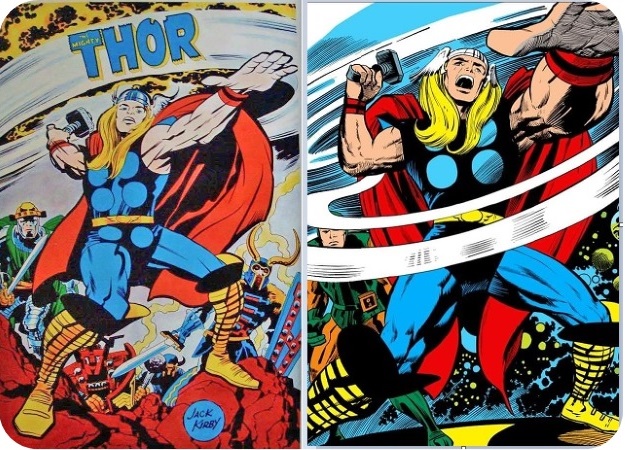
Kirby Colletta Thor ComparisonMuch has been made of how Colletta “changed” Kirby’s pencils. Many of Jack’s more enthusiastic followers claim that Vince’s inking “diminished” the energy portrayed in the layouts. Jack Kirby is purported to have penciled AND inked the image on the left showing Thor swinging his hammer. Most of his fans – going by what appears online in debates that will seemingly never end – prefer unadulterated Jack. If comic books could be reproduced from pencils, they would prefer that no inker ever touched his art. But the inks were necessary for the images to be replicated by printing presses. Compare the side-by-side images of Thor…All Kirby on the left and Kirby–Colletta on the right. Is there more vigor in the Kirby image? Does Colletta’s inking reduce the dynamism of the picture?

One comic book reader wrote: “Granted, Colletta’s inks do not work for every penciler, but anyone who doesn’t recognize the majesty of how Colletta inked Kirby on THOR simply does not have an eye for mythology.  Thor and the Asgardian gods have never looked more massive and imposing as when Colletta inked them. Kirby’s art is easily gold all by itself, but when it came to rendering the gods, Colletta made them hulking and sinewy and savage-looking, their bodily frames monstrous, beastly and hirsute.”

And, another comic-book reader wrote: “I am an artist and Colletta is like bad music. He can’t draw faces, and for all his “fine lines” important details in the pencils disappear with his inks. I am sick to death of seeing this ongoing representation continuously being posted- it’s not the Kirby I fell in love with, so many, many examples of inkers who did right by him, including himself. Because I don’t like one of them devalues my opinion? Colletta is no Hal Foster, no Alex Raymond, no Caniff or Kubert. Colletta is not suitable for or deserving of inking Jack Kirby’s pencils.”

Index of articles www.vincecolletta.com

GET LOST, THOR….

Vince Colletta Romance Covers

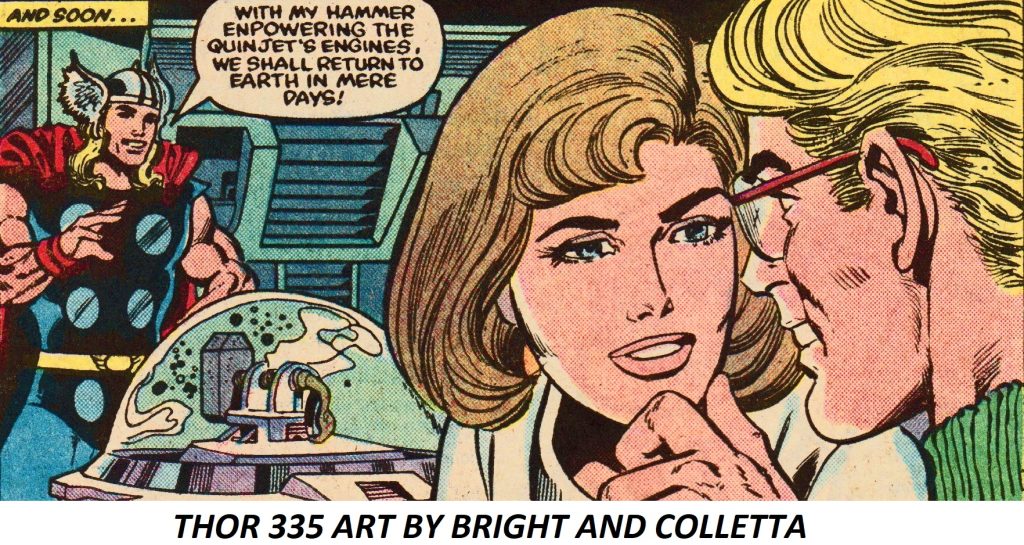
The central character in Thor comics is, well…Thor, of course. In this particular panel, however, he clearly finds himself an uninvited interloper. If a comic book character ever showed lust, Mark Bright and Vince Colletta have captured the emotion perfectly in Jane Foster’s eyes. We know what’s about to happen. Things are about to get steamy and, Thor, you’re being summoned to leave the premises. Don’t come a’knockin if the lab’s still a’rockin’.

Thor 335 art by Bright and Colletta

Depicting sexual passion in a superhero comic book is unusual – especially in a female character. The mental paraphernalia that is necessary to generate with a pen, such a simple, yet resolute stare, that is clear in it’s intention, goes way beyond art. More like an understanding of how to portray sensations.

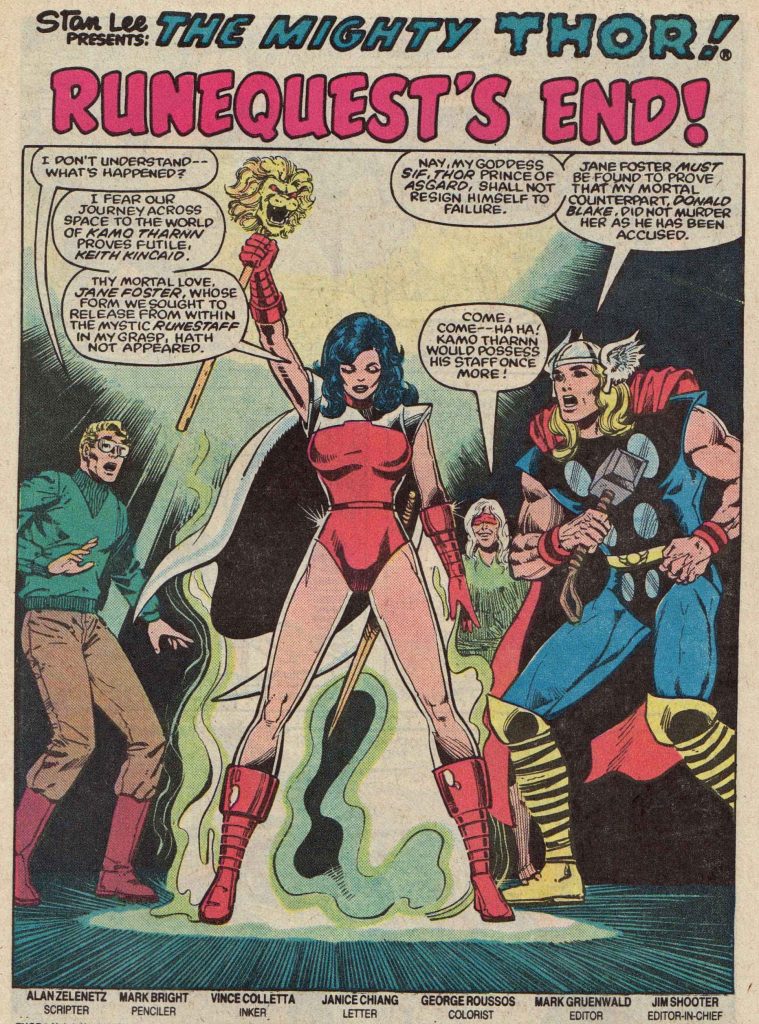
Thor 335 art by Mark Bright and Vince Colletta

Sif, on the other hand, is in a different state of mind. Find Thor 335 on EBay to find out what happens and treat yourself to some incredible, indelible Thor art from Mark Bright and Vince Colletta.

Index of articles www.vincecolletta.com

THE STAN LEE EFFECT

Vince Colletta Romance Covers

Stan Lee, Marvel’s former Editor in Chief and Colletta’s former boss: – “Just mention the name Vinnie Colletta and the first thing that comes to mind is his gorgeous portrayal of beautiful females in his artwork.

When I first met Vinnie and he showed me his art samples I was overwhelmed. I had never seen anyone depict beautiful women in romance stories as dramatically or as glamorously.

Years later, when the trend turned to superhero stories, Vince showed his amazing versatility by becoming a terrific inker of many of our main characters, with the countless issues he inked of Thor being his most memorable.

Not only was Vincent Colletta extremely talented, but he was also one of our most dependable artists. If ever another artist became ill and couldn’t meet his deadline, I can’t remember the number of times I’d give the assignment to Vinnie who would work through the night and inevitably deliver the work on time.

Indeed, Vincent Colletta was a fine artist, a valued co-worker and a dear friend whose work will be long remembered.”

vincecolletta.com/the-stan-lee-effect/

Martin Pasko, Veteran writer: I think Vince Colletta was one of the best inkers of his generation in the comics business, but — sadly, IMO — his reputation suffered unfairly for his consummate professionalism. Vinnie was the guy so many editors came to rely on to make up the time in the schedule lost to writers’ and pencillers’ slowness. Vinnie often had to cut corners — such as scrimping on backgrounds — to turn the pages around in time. And after SOME, but not all, editors had happily put the books “to bed,” they — and the fans — would talk trash about Vinnie being a hack — conveniently forgetting that NO creative choice Vinnie made was EVER in sacrifice to the clarity of the storytelling and what the reader was paying for. I always thought the way he was regarded in some quarters was grossly unfair…
…because I WORKED with him, and I saw what he could do when allowed to do it (he was a good penciller, too, but he never got much of a shot at it except on the romance books)…and I remember all the magnificent ink work he did, over guys like Jack Kirby and Gil Kane and many others, when he was Given. Enough. Time. To Be. The Best. He could be. Which was, IMO, magnificent.

Frankie, Vince is honored by having a son who respects his memory as you do, because it’s a testament to a guy who apparently did in his personal life what I always knew he did in his professional one: his best.

vincecolletta.com/the-stan-lee-effect/

For readers not familiar with Vince Colletta, my father was an artist and inker, known primarily for his exquisite romance art and, later on, his contributions to the superhero genre. Debates over his techniques and methods will probably never subside.

Stefan Etrigan: For those of you who can’t be bothered to look, it’s the beautiful cover to FOREVER PEOPLE #3 by Jack Kirby, with surprisingly lovely inks by Vince Colletta.

Jose: I’ve always said Vinnie Colletta was pretty good, when he wanted to be. So I’m glad he’s in my sketchbook.

Ken Quattro:  Mike’s quest of Romita art has undoubtedly affected the going prices of Romita art. But unless others also treasured that art as well, then Mike would be paying far less. It takes more than one person to affect the market. If he was “hoarding” Vince Colletta art, we wouldn’t even be having this conversation.

Richard Howell: If you’re one of those who enjoy the Kirby/Colletta THOR collaboration–and there are many who agree with you (many who don’t, too)–you’re in luck, because there are many, many pages from those issues on the market.

Doc V.: To which I’ll add that if anyone wants to get rid of that “crappy” Colletta romance art they might have, I’d gladly take it off your hands.

Ray Cuthbert: When the great inker Vince Colletta left the Kirby “Fourth World” books, Colletta’s rounded and romantic finesse was sadly lacking after that…

Ben Herman: No offense, Ray, but I have to disagree completely. When Kirby got rid of Vinnie “my best friend is my eraser” Colletta, the art improved.

Ray Cuthbert: No offense taken. My point is merely this: I liked Vince Colletta’s inking on Kirby most of the time. Vince had plenty of faults as an inker (like his erasures), but I liked what he brought to the table on Kirby’s work. There are only three inkers who worked on Kirby that I can think of who made Jack’s women look attractive — Wood, Sinnott and Colletta. Vince’s work as a top-flight romance artist made his inking of Kirby particularly appealing in my eyes.

Loston Wallace: I never cared much for Colletta’s inks over Jack, but I don’t hate them. In fact, I feel Colletta has gotten a little of a bum rap. Sure. He erased, hacked, and altered, but he was a professional. He got the job done. Mediocre or not, he was dependable. Don’t get me wrong. If Vinnie were alive today, I’d pray that he wouldn’t be the guy assigned to ink me. But there are two sides to every story. It seems Vinnie was interested in making money, not art. He was true to his convictions.

Tony Fornaro: How anyone can look at those Kirby/Colletta Thor’s and say “what crappy inks.” is beyond me. I personally believe that was the best Kirby art ever.

Greg Huneryager: I found the gallery very entertaining/ informative. It’s interesting but Colletta  doesn’t seem to be that bad a match with Toth.

Ken Quattro: I agree about Colletta’s inks over Alex Toth. As bad a rap as he gets for what he did with Kirby’s pencils, Colletta “fit” Toth nicely. Given the fact that he inked Toth frequently, I’d assume that Toth approved of his work. Toth didn’t much care for inkers who overworked his pencils and put their imprint on them. Colletta’s “strength” was that he used a spare line.

Ken: Just curious,…(and pardon my ignorance on this) but is Vince Colletta still with us? I know little about him other than, unlike many out there, I sincerely enjoyed his work on early Kirby Thor pages. As a matter of fact when and if I ever break down to get my example of Kirby (my TOS by Colan has to come first!) then a Thor page with Colletta inks would probably be my choice!

AH: ouch better be careful mentioning something like that can get you into trouble on this list =O. AH remembers the last Colletta arguments!

vincecolletta.com/the-stan-lee-effect/

Paul Smith (Former Marvel and DC penciler): Vinnie did brilliant work at DC. Adams, Kane, Kirby, Vosburg, Grell and a host of lesser artists that no inker could’ve saved. You’re free not to like it but it doesn’t change the fact that Vinnie was one of the best.

John Byrne (Former Marvel and DC penciler): I always enjoyed the time I spent hanging out with Vinnie in the bullpen.

Erik Larsen: (Former Marvel and DC penciler):Years later, I look back and get a kick out of it. It was the last issue of Thor that Vinnie Colletta ever inked and the last issue Stan Lee ever scripted, so it was like I was filling in for Jack Kirby as part of the classic Thor creative team. In retrospect, it really wasn’t as bad as I seemed to think it was. And it one case, what I took to be a shortcut on Vinnie’s part aided the storytelling. Vinnie had made an incidental foreground figure bald, which, in retrospect, eliminated a distraction that helped focus the readers attention on what it should have been focused on: the battle, which raged behind him. This foreground figure was unimportant — the battle was.

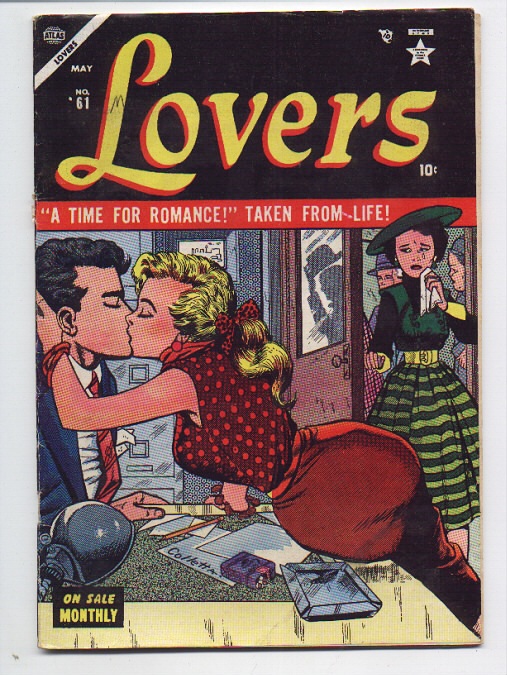
Stan had a good eye for talent. Starting his career at Standard Comics, Colletta was soon chosen to illustrate almost every cover in the Timely-Atlas romance library. Throughout the 1950s and early 1960s, Vince’s good girl art in the romance books helped draw attention to the fledgling publishing company that would one day become Marvel Comics.

Index of articles www.vincecolletta.com